Transitioning away from fossil fuels: creating space for those willing to move first
Daniela Campos reports back from the Santa Marta conference on transitioning away from fossil fuels.
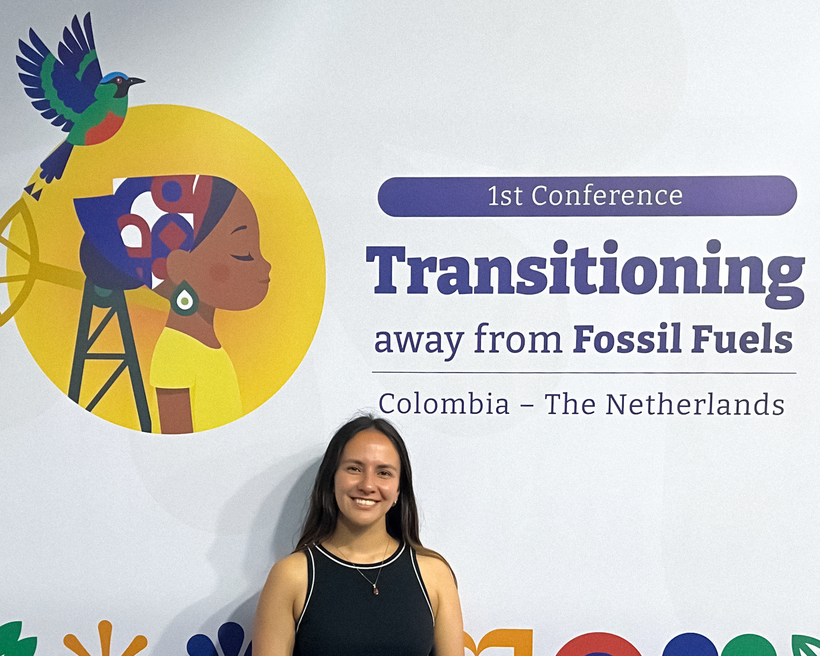
Last week, 57 countries and more than 2,000 organisations met in Santa Marta, Colombia, to discuss how to reduce dependency on fossil fuels. This First International Conference to Transition Away from Fossil Fuels was more than a diplomatic gathering: it signalled emerging political space for actors willing to move this agenda forward. It was a space of cautious hope.
The Quaker United Nations Office (QUNO Geneva), representing Friends World Committee for Consultation, had the opportunity to be present in Colombia's Caribbean region and to be a witness to Friends' concerns and values at this potentially historic moment.
Marking a turning point?
The main driver of greenhouse gas emissions (GHG) is the burning of fossil fuels – coal, oil, and gas. Three years ago, at COP28 in Dubai, states called for "transitioning away from fossil fuels". Yet progress within the United Nations Framework Convention on Climate Change (UNFCCC) has since stalled, blocked by a small number of countries under consensus-based rules.
The frustration was palpable at COP30, where more than 80 countries found themselves unable to meaningfully address fossil fuels at the world's central climate forum. Amid this blockade, Colombia, together with the Netherlands, stepped in to create a parallel space for countries willing to address the issue. Colombia's leadership carries particular weight: a Global South country, economically reliant on coal and oil exports, choosing nonetheless to face the contradictions of that dependency.
In less than five months, Colombia and the Netherlands co-designed a new kind of gathering. This was not a negotiation table but, as one diplomat put it, "a safe space to start having those difficult conversations". The concept closely reflects the spirit of QUNO's quiet diplomacy work over the past 13 years in the climate negotiations, bringing together a diverse group of negotiators to discuss sensitive issues in a safe, off-the-record setting.
Creating dialogue
The three pillars identified by the conference were: addressing producer countries' economic dependency, transforming both supply and demand, and reinvigorating multilateralism. The Netherlands' Minister, Stientje van Veldhoven, observed that the absence of formal negotiations shifted the dynamic – delegates arrived with a different psychology, more open to dialogue. Still, there was agreement that this process must complement, not replace, the UNFCCC.
Another notable shift was the role of non-state actors. Civil society, Indigenous peoples, academics, scientists and the private sector, among others, were invited not just as observers but were encouraged to convey and produce inputs that could feed into state-led processes.
QUNO contributed to the Academic Conference, participated in the Global NGOs section of the Pre-Assembly of the Peoples, engaged with state representatives, and joined side events. While some participatory processes could have been improved, it was invigorating to witness the hope and optimism of people from around the world.
The conference fostered a focus on action and solutions, rather than merely describing problems. It also brought critical tensions of a just transition to the forefront: the need to reform fossil fuel subsidies and the Investor-State Dispute Settlement system of corporate courts, and the need to ensure that new energy solutions do not reproduce human rights violations or economic inequalities.
Outcomes and next steps
The conference yielded five notable outcomes. First, it sent a clear political signal that a growing coalition of countries is ready to cooperate in moving beyond fossil fuels. Second, it launched the voluntary development of national or regional defossilisation roadmaps. As Colombia's Minister argued, these could complement NDCs (each country's plan to cut emissions, known as nationally determined contributions) by addressing emissions linked to exports – an often-overlooked dimension for producer countries. France and Colombia were the first to present initial roadmaps.
Third, it confirmed a Second International Conference in 2027 in Tuvalu, co-hosted by Ireland, extending a model of shared Global South–North leadership. Fourth, it launched a scientific panel to support states in their defossilisation efforts. Fifth, it invited states to contribute to a transparency methodology for mapping how fossil fuels are embedded in their socio-economic systems – a potentially important step in making subsidies and dependencies more visible.
It is true that major emitters and global powers were absent. But the coalition present represented, as Minister Irene Vélez noted, half of global GDP, one-third of energy demand, and one-fifth of fossil fuel supply. At a time when faith in multilateralism is under strain, this conference offers a reminder that progress does not always begin with unanimity. Sometimes it begins with those willing to move first – and to create space for others to follow.