My most profound Quaker experiences weren’t in meeting for worship
Epilogue, as used by young Friends, can create very powerful Quaker worship. Matt Alton reflects on what we can learn from his experience and research.
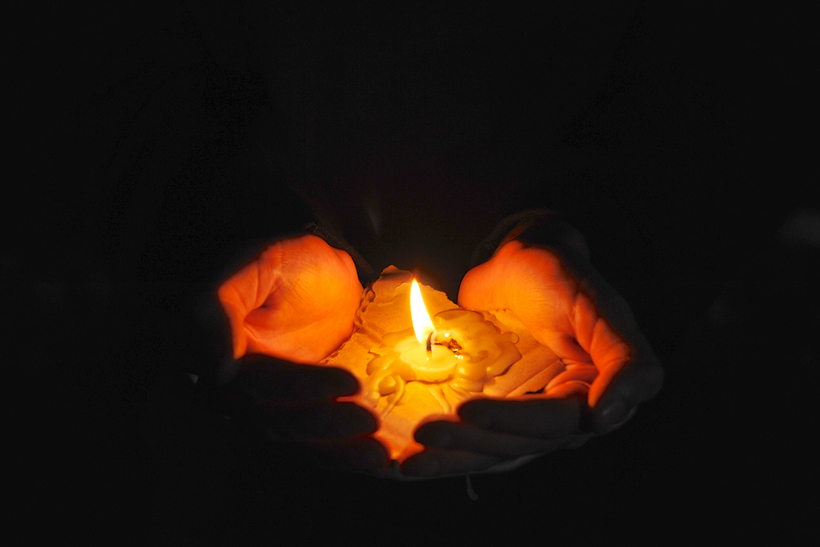
I enter a darkened room, the only light coming from a scattering of electric candles, and through the tall windows, cracked to the warm evening. A circle of chairs is laid out around the edge, but I choose a cushion on the floor. Quakers aged 18-35 pad into the room in sock feet, some already wearing nightclothes, many carrying pillows and blankets. Some choose chairs, many sit or lie on the floor, making sure to maintain our circle. Occasional Saturday night whoops drift into our silence – I think to myself: they're having their fun, and we're having ours.
Over the last 24 hours this space has been host to Quaker decision making, talks and workshops, games, snacking, cleaning, tooth brushing and sleeping, but now the silence of fifty worshippers deepens. After five minutes, an Elder begins to speak about spiritual gifts. They invite us to write one of our own and one of another YFGM member on a card tag, to be tied to a makeshift tree later. The squeaking of felt tip pens rises then fades, and silence settles again. After five minutes, the worship is closed by each person holding hands with their neighbours - some giggling as they twist and reach to ensure each person is included in the circle.
How do Quakers worship?
British Quakers, and those researching us, generally agree that the way we worship has changed very little over our 370 year history. We sit in expectant silence, and apart from occasional planned readings from Quaker faith & practice, the only spoken contributions occur when a worshipper is spontaneously moved to speak by God (or however the individual understands it). My experiences worshipping in many settings other to local meetings have led me to question this conventional wisdom.
Growing up, some of my most profound Quaker experiences were in epilogues – evening worship which usually contains a planned element. A thousand people of all ages holding hands around York University's lake, floating paper cranes and tea lights on the water to commemorate the 60th anniversary of the atom bomb being dropped on Hiroshima. Eighty adolescents together for an intense week of spirituality and laughter, asserting their commitment to peace by singing along to Willy Mason's Oxygen. These are the times I have felt most connected to something I might call Divine within myself and the people around me.
Researching epilogue
In 2019, I conducted research into the use of epilogue by Young Friends General Meeting (YFGM), the representative body of young adult Quakers in Britain. I wanted to understand what the practice means to the individuals and community of YFGM. My research was partially funded by a Living Adventurously Grant, a fund which was designed to support young adults in service they felt led to do as part of their Quaker witness.
A significant theme in my research was that YFGM participants have ownership over the space. At local meetings, due to the voluntary nature of service, it's common for the majority of roles to be held by retired people and few to be held by younger people who may not have the time to commit. At YFGM, every role – Elders, Clerks, Caterers – is carried out by a young adult. On a smaller scale, the room where epilogue takes place is arranged by participants: cushions are laid out because many feel more comfortable on the floor; a single circle allows for the joining of hands at the end.
Elders only decide on their contribution for epilogue when the rest of the day's timetable is complete, because a YFGM epilogue should respond – directly or indirectly – to the day's events. A stressful day might require a meditative activity; after an energetic or joyful day the Elders find a way to channel those feelings into the worship. Participants recognise that epilogue is 'full of the day' in a way that a morning meeting for worship doesn't respond to time spent together.
In a YFGM epilogue, the importance placed on the physical comfort of worshippers shows them their needs are understood and taken seriously. The single circle and joining of hands to close communicates the group's equality, even more so than in a meeting for worship where chairs are arranged in tiered circles and hands are shaken. A prepared contribution which responds to time spent together emphasises that YFGM is a place where experiences and feelings are shared, whether they are challenging or uplifting. These elements of epilogue contribute to group cohesion and enable communal spiritual experience.
Learning from epilogue
Though there are many things unique about a YFGM epilogue, anyone organising worship can learn from it. Here are some questions to consider:
- How can each person authentically contribute to the organisation of all age worship, so everyone feels ownership?
- Would it be possible for your Quaker community to worship in a single circle and join hands to close worship?
- Are there people who struggle to get the most out of worship or don't come because the space doesn't meet their needs? What would it look like to make your worship space more comfortable and accessible?
- Could you explore holding worship with a planned element that follows and responds to other shared activities, such as a meal, quiz night, or walk?