Challenging antisemitism: a new guide for Quakers
A guide for Quakers on challenging antisemitism launched this week. Oliver Robertson explains why this was needed.
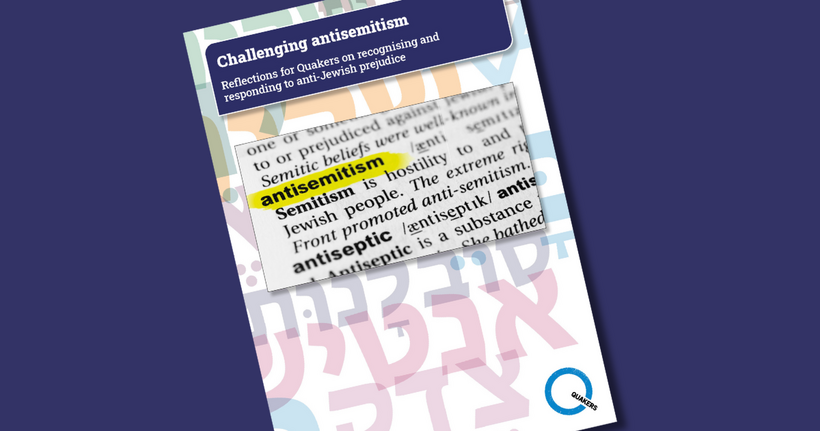
Why do we need a guide specially for Quakers about antisemitism? Aren't there already lots of guides out there? And shouldn't Quakers do the same things as everyone else to recognise and challenge antisemitism?
Well, yes and no. Friends have often responded better to guidance put out by Quakers rather than other groups, and we can word it in ways that we hope will be well heard by Quaker readers. But also, we wanted to focus on issues that may be especially pertinent to Quakers, such as voicing support for Palestine in a way that avoids antisemitism.
A need for guidance for British Quakers
There are cases of antisemitism among Quakers. These include treating Holocaust Memorial Day events as suspect on the grounds that they take attention away from other genocides, or hosting speakers who deny that there's been any serious antisemitism in Britain since the 1950s. But the aim is not to point fingers or condemn, rather to inform so that people are aware of the impact of their words and actions, and change. In the hosting example above, the Friends involved later challenged such views when voiced by others.
There has been advice about antisemitism for many years for Ecumenical Accompaniers, the human rights volunteers who spend three months at a time in Palestine and Israel. But Britain is not the Middle East, and British Quakers are far more likely to meet British Jews than Israeli Jews, so we needed something different.
Including diverse views and nuances
Writing this has involved a lot of speaking with people who have direct experience of antisemitism – because they are (or have been mistaken as) Jewish, or because their work is about challenging antisemitism. Some are Quakers, some are not. Different people had very different, occasionally directly opposed, views. In such cases, the guide doesn't come down on one side or the other. Instead, it names the tensions so that readers are aware of the minefields they could be walking in to.
The most striking example of this is around definitions of antisemitism. Two of the most widely known are the International Holocaust Remembrance Alliance working definition of antisemitism, and the later Jerusalem Declaration on Antisemitism. Different reviewers felt that one or the other was problematic or suspect; the guide explains:
[QUOTE-START]
Some have explained that the Jerusalem Declaration is used mainly by politically left-wing groups and that many Jews will immediately suspect a document which promotes it. Some have argued that the IHRA is used to stifle legitimate criticism of Israel and is used as a definitive description in a way that was never intended.
[QUOTE-END]
Similarly, while there is a long list of examples of antisemitism in the guide, it doesn't say "It's okay to say X and it's not okay to do Y". This is because, as with other types of racism, context matters, but so too does the reaction of the person on the receiving end. What the guide does do is explain some of the issues, stereotypes and tropes that can make things antisemitic, and describe the various ways to respond if you witness antisemitism or are accused of it yourself.
The aim of the guide
The hope with this is to prevent antisemitism among Quakers, deliberate or unintentional. It's one part of a much wider programme of work on anti-racism, and a way to build links with more parts of the diverse society in Britain today. Copies of the guide have been sent to each local Quaker meeting, and are available to order or download online (PDF).
So what should Quakers do with the guide now we have it? Firstly, read it – all the way through at least once, as each section flows from the previous one. Secondly, discuss it with others in your meeting or Quaker community. Thirdly, put it into practice, for example by reaching out to a local Jewish community and synagogue.
When people are feeling under threat or attacked, as many Jews in Britain do today, a warm welcome and offer of friendship can be a ray of sunshine. Interfaith relations and working against hate isn't just for a single named Quaker representative – as with spiritual and pastoral care in our communities, particular people may be appointed but the work is for all of us to do.