
Enslavement - the 'gravest crime against humanity'
Quakers on the Trustees' Reparations Working Group have welcomed a landmark United Nations resolution acknowledging historic enslavement as the 'gravest crime against humanity.'
The resolution, spearheaded by Ghana, received 123 votes in favour, with three countries—Israel, the United States and Argentina, voting against. There were 52 abstentions, including the United Kingdom and all European Union member states.
"The UN General Assembly adopted the resolution recognising the transatlantic slave trade as the gravest crime against humanity and calling for reparations, including apologies, restitution, and structural reforms," explained Ann Morgan, Co-Clerk of the Britain Yearly Meeting Trustees' Reparations Working Group. “While not legally binding, the resolution represents a significant moral and political statement on the global stage."
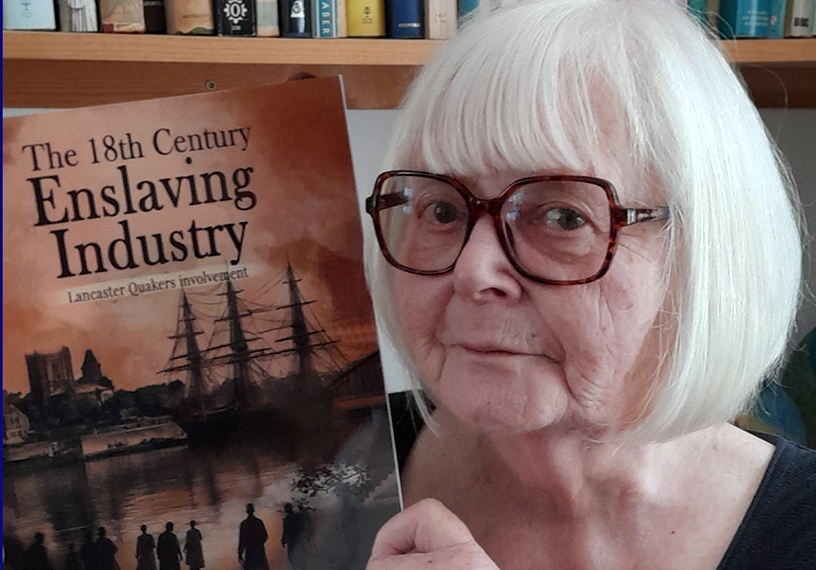
Ann, a Lancaster Friend, taught history and sociology for 26 years and became drawn to finding out more about the history of Quakers and the trafficking of people of colour after hearing about 'Sambo's Grave'.
"Sambo (or Samboo) was an enslaved child who had travelled with their master from Africa to Lancaster in about 1736. Sadly, he died shortly after arriving here," explained Ann. "He was buried in an unmarked grave in a field near the village of Sunderland Point in Lancashire where the port there handled slave ships, cotton, and sugar from the West Indies and North America."
He lay there for 60 years until a local schoolteacher, the Rev. James Watson erected a gravestone and wrote a eulogy to the enslaved boy.
"Ironically, Rev Watson was the brother of William, a prolific Lancaster enslaver who married into the Quaker Satterthwaite family who also profited from enslavement," said Ann, "and they weren't the only ones."
When Ann started to research the relationship between enslavement and Quakers she uncovered a story that didn't completely align with the historic view of Quakers driving the push for abolition.
"There were 18 Lancaster Quaker merchants and two Quaker women who were directly involved in trafficking," explained Ann, "and in some cases they owned enslaved people on their plantations. In addition, other Lancaster Quaker merchants traded in goods produced by the enslaved."
Lancaster Friends have created and publicly displayed an engraved plaque acknowledging this part of their history. It's speculated that Quakers in Lancaster trafficked more than 3,500 Africans.
Ann has now written a book about the Lancaster Quaker families who benefitted from the profits of people trafficking.
"There were Quakers across the UK and the world who continued to trade in trafficked people even when YM called for its abolition," said Ann. "The money generated by enslaving Africans came back into British society to finance infrastructure projects such as canals, turnpikes and country houses, to establish banks and cotton mills supporting the development of the industrial revolution, to provide community welfare projects and enhanced social status for the families. "Their money made a major contribution to building the society in which we live and from which we benefit today at the expense of the labour and lives of past enslaved Africans. That's why I believe it's so important we acknowledge our wrongs and try to find ways of making amends."
The Yearly Meeting's Reparation Working Group continues to commission further research into Quaker-related enslavement, with a view to making recommendations on how we can meaningfully offer reparation whilst recognising we can't ever properly compensate the people and communities we wronged.
The group is currently planning a day-long conference on 23 October 2026, 10am–4pm at Friends House (in-person and online) where they'll share the results of their historical and theological research.
If you're attending May's Yearly Meeting in London look out for their information stand at the Groups Fair. They'll also be highlighting their work on 18 July at Yearly Meeting in Manchester.
Find out more about the group's work.
Buy Ann's book here from the Quaker Bookshop.
If you'd like to know more about what's going on in your local area, get in touch with your Local Development Worker.