Women's preaching still justified
For International Women's Day, Rhiannon Grant reflects on early Quaker support for women's religious leadership ahead of a modern translation of Margaret Fell's seminal text.
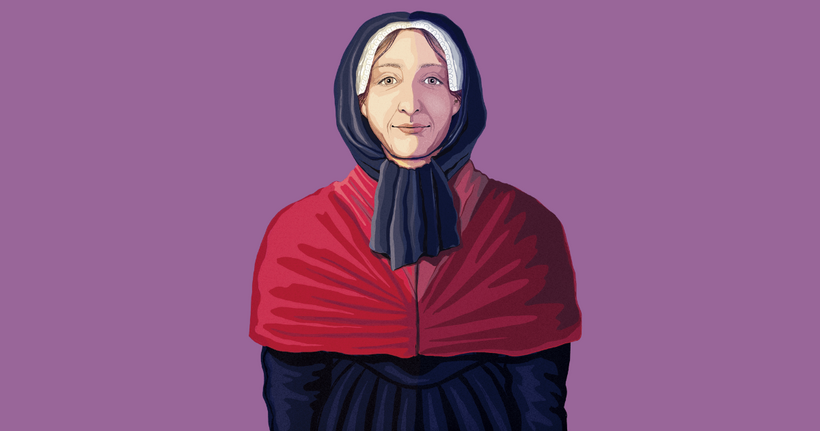
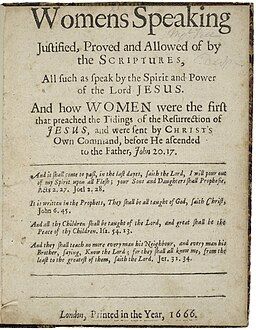
Margaret Fell (1614-1702) was a key figure in the development of the early Quaker movement, handling money, letters, and practical support for people who felt led to preach the Quaker message. Quakers were criticised for allowing women to speak, and so – while she was in prison for allowing a Quaker meeting to be held in her home – Fell wrote a pamphlet, Women's speaking justified. In it she went through Biblical examples to show that women could, and always had, shared the word of God.
Fell knew the Scriptures inside and out, and she jumps around the text to make connections between different passages. For example, she seems for a moment to be starting at the beginning, in Genesis, with the creation of Adam and Eve. She notes that God joins them both, man and woman, in God's own image, and "makes no such distinctions and differences" as people do.
This is, she says, possible because although people are weak, God is strong: and she leaps into the New Testament, to Paul's first epistle to the Corinthians, to strengthen this by reminding the reader that "God chose what is weak in the world to shame the strong" (1 Cor 1:27, NSRV). Given that God can effect that reversal, of course it's within God's power to ignore differences human beings might put between genders.
"If the Seed of the Woman speak not, the Seed of the Serpent speaks"
Going back to Genesis, Fell explains how the story of the encounter between Eve and the serpent shows that Eve spoke the truth – after eating the apple, she tells God what she did. As a result, God says to the serpent, “I will put enmity between you and the woman" (Gen 3:15, NRSV).Fell says this division should "stop the mouths of all that oppose Womens Speaking in the Power of the Lord" because in the context of this enmity, to stop women from speaking is to support the serpent and thereby the forces of evil.
I think we can infer from this that she would have some strong things to say about people on social media who are complaining about Sarah Mullally's new role in the Church of England, not to mention those trying to silence the voices of many other women who are routinely threatened and insulted online.
God "gave his good Spirit, as it pleased him, both to Man and Woman"
Fell has plenty of other examples of women in the Bible who were given God's Spirit in various ways. She mentions Deborah, a judge and prophet (Judges 4); Huldah, who was consulted for God's word (2 Kings 22 and 2 Chronicles 34); and Sarah, blessed by God in Genesis 17.
There are also the women around Jesus: the woman of Samaria at the well, who Jesus tells more about his role as Messiah than anyone else before his death (in John 4), and Martha's true faith in John 11, and the woman with the alabaster box who anointed Jesus (in Matthew 26, Mark 14, and Luke 7). Fell points out that "this Woman knew more of the secret Power and Wisdom of God, then his Disciples did, that were filled with indignation against her".
It doesn't stop there. Drawing on Acts, Fell shows that women like Aquila and Priscilla were important in the early church. Over and over, she is able to demonstrate that women have been perfectly able to understand and express God's truth.
"Pray therefore for us, for thou art an holy Woman"
In the final section of her argument, Fell discusses the story of Judith (told in the book of Judith, an ancient text not included in the Hebrew Bible or Protestant canon but found in Catholic and Orthodox Bibles). Judith is a prophet and her words are heard: "All that you have said was spoken out of a true heart, and there is no one who can deny your words" (8:28, NRSV). Seeing this, the people recognise her as a holy woman and ask her to pray for them.
Fell contrasts the people in this story with hypocritical religious leaders of her own day, with a Biblically familiar but unfortunately ableist term: "you blind Priests… will make a Trade of Womens words to get money by, and take Texts, and Preach Sermons upon Womens words; and still cry out, Women must not speak, Women must be silent".
Today, the Quaker community seeks to uphold women in all areas of life, to believe what women say, and to support their leadership and callings in all faith communities. When anyone speaks out of a true heart, providing an authentic witness to God's voice, questions of gender or other humanly-created division should not prevent us from hearing them.
A new version of Margaret Fell's pamphlet in modern English will be published by Barclay Press later this year. You can order via the Quaker Bookshop. In the meantime, read a digitised copy of the original text from the University of Pennsylvania.