Whistles, not guns: learning from nonviolent civilian defence in Minnesota
Rebecca Bellamy reflects on what we can learn from civil resistance and community solidarity movements in Minnesota and elsewhere.
"We need to get ahead!" I've been hearing this in many conversations. Ahead of things we might rather not imagine. Things like resource scarcity, violent civil unrest, critical weather incidents, or other unwanted scenarios.
Imagining what could be does not have to be fatalistic. When we imagine we can share stories of resistance and solidarity – of people protecting people, stories that are not just woven into our Quaker history, but are very much stories of today. And through imagining we can seek to strengthen our connections, build knowledge and skills, and prepare for the tricky or even dangerous times that may lie ahead. Noting that many already face tricky and dangerous things in their lives.
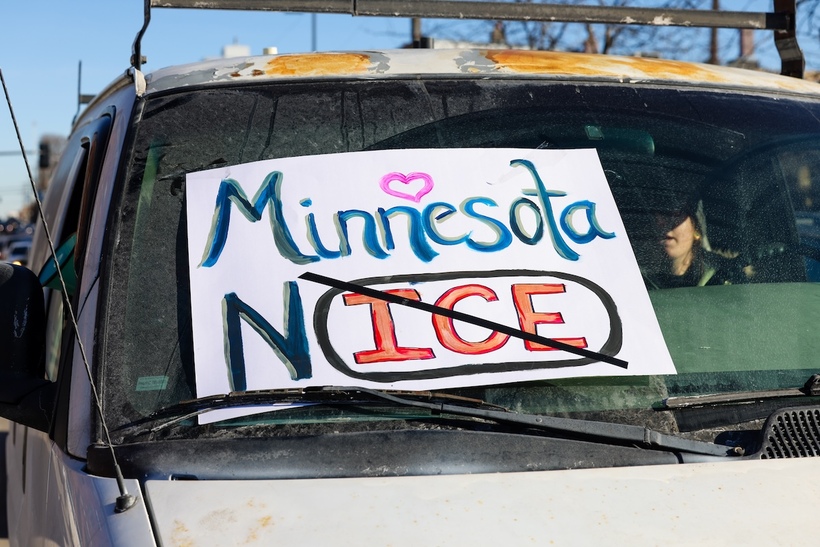
As part of my role in the Peacebuilding in Britain programme, I convene the Quaker Peacebuilding Network. When members suggested there would be value in learning from recent and ongoing events in the USA we invited Betsy Raasch-Gilman, a Quaker activist in Minneapolis–St. Paul (Minnesota) to speak with us in July. Betsy is part of a movement using nonviolent civilian defence to protect people in their community from federal immigration agents. Betsy and others have worked to protect families and individuals at risk using school patrols, rapid response networks, mutual aid, and direct intervention.
Building a strong civil society
We heard from Betsy that Minnesotans learned from campaigns and past movements such as Black Lives Matter from which a strong civil society with grassroots faith, voluntary, and community organisations and networks emerged.
Writing in The Conversation, Daniel Cueto-Villalobos writes how neighbourhood groups in Minnesota responding to ICE (Immigration and Customs Enforcement) connect back to the "mutual networks set up during the 2020 Covid pandemic, and in the wake of the murder of George Floyd by a Minneapolis policeman".
Responding with 'civilian-based defence'
Betsy talked in detail about the way in which Minnesotans responded to ICE agents who they saw as an invading force, "we followed application of political nonviolence called civilian-based defence. What do you do when an army invades your country? That's what we did. We met an invading army with whistles. They had guns, we had whistles. They were dressed in uniforms, we were dressed in slippers and our bathrobes. That was civilian-based defence. And we expelled the majority of the army using these methods."
Betsy explained that the situation in Minnesota has shifted since the early part of 2026 and many people have returned to their normal daily lives. But with family, friends and neighbours missing since abductions, we heard that there are still deep open wounds, heartbreak and injustice.
Learning from Minnesota
Britain is a different context but there are similar echoes in the UK with reports that some political parties are proposing mass deportation and an ICE-style deportation agency. Within this context, what might we learn from movements in places like Minnesota as well as stories of resistance in Britain and other places?
Betsy's account had a significant impact on those of us who heard her story of community solidarity. It inspired questions within our Quaker Peacebuilding Network about the need for further reflection on our own context and what we might need in expectation of the unexpected.
We also thought Betsy's story would be of interest to those beyond our network and Betsy has kindly agreed to share her story again in an online webinar open to all Quakers in Britain and Ireland, alongside any friends and connections you think might be interested.
Invitation: Betsy Raasch-Gilman Talk, Thursday 1 October 7-8.30pm (online)
We have also planned a follow up meeting on 15 October, 7-8.30pm. This second online discussion space will provide an opportunity for those who heard from Betsy to share thoughts on what may lie ahead in the British context and what might help us 'get ahead'.
Find resources to address violence and conflict locally and nationally