Telling a better story: Tax and climate justice
How could tax help us address the climate emergency? Tanya Jones considers some principles arising from Quaker faith which might help us use tax for justice.

“[We] need to tell a broad story about the benefits of a just system of taxation, and to have the freedom to imagine what a holistic system may look like."
Economics & Sustainability Subcommittee, minute ES 18/34. November 2018
The climate emergency is not just a crisis of emissions, but a crisis of justice, both globally and locally. Climate chaos is deepening, and so are the chasms of economic inequality and social division. We desperately need a transition away from fossil fuels that is fast, fair and properly funded. We know that the costs of climate inaction would be catastrophic, in financial, ecological and human terms. And yet we are hearing increasingly strident voices claiming that we cannot afford to act.
Quakers have recognised the need to address climate justice, both globally and locally. We need mitigation (the reduction of greenhouse gas emissions), adaptation to a climate-changed world and compensation for loss and damage, those negative impacts which adaption cannot or will not remove.
Like many others, within the Make Polluters Pay coalition and elsewhere, Quakers have been talking about tax and how it can create and protect a just and sustainable future.
Quakers in Scotland has very recently made the decision to join Tax Justice Scotland a coalition seeking fairer and greener taxation in Scotland. A recent campaigning success is that the Scottish Government announced a new private jet tax as part of a broader review of air departure taxation.
Tax is important, but tax alone can't do everything. We also urge a sense of responsibility among the biggest carbon emitters, including rich individuals and corporations. And we call upon our government to recognise and use the other economic tools at its disposal.
Tax and testimonies
Our Quaker faith leads us to try and put our spiritual values into action in the world, and a good tax policy can help with this in a number of ways.
Peace: The roots of war are economic as well as political, and growing inequality intensifies the risk of violence. Quaker writer and campaigner Richard Murphy has described how tax can reduce conflict within societies, lessening inequality, meeting people's basic needs and using resources wisely and fairly. In this way, tax can be one part of achieving a just peace.
Equality: Quakers, inspired by our sense of each person's worth, have long borne witness to the damage done by inequality, locally and globally. We have a responsibility to speak out against unfair systems that tax the poor relatively more than the rich. We call for just redistribution of wealth, not out of envy or punishment but as a question of care and shared responsibility, recognising our common vulnerability. The Gospel accounts of Jesus looking on the rich young man speak of compassion, not revenge, and the call to redistribution is clear and compelling. "And Jesus, looking at him, loved him and said to him, 'You lack a single thing: Go, sell whatever you possess and give to the destitute'" (Mark 10:21, trans. David Bentley Hart).
Simplicity and sustainability: Quakers have an enduring concern about the impacts of luxury consumption on humans and non-human nature, and about the destructive effects of wealth and power. In the intersecting crises of climate, biodiversity and ecological degradation we are beginning to sense the earth's limits, and to focus on sharing and stewardship.
Truth: Richard Murphy writes that, if our tax system is to have integrity, it needs a genuinely democratic political system, transparency by corporations, and action on tax havens, more accurately called secrecy jurisdictions. As Quakers, our responsibility to speak truth to power leads us to express our alternative vision: a shared and joyful future made possible by wise and careful decision making.
What tax can do
- Revenue raising, funding public services, infrastructure and administration. In a climate context, it can help us realise a vision of just community, including human and non-human nature, and building resilience for present and future generations.
- Redistribution, to reduce inequalities and prevent the concentration of wealth in too few hands. The climate crisis requires us to distribute and redistribute access to resources of many kinds: natural, financial, social and cultural.
- Repricing, encouraging and discouraging behaviours, including facilitating the rapid phase-out of oil, coal and gas.
- Representation, recognising tax as a social contract and encouraging effective and healthy democratic participation in society. For us this may include expressing solidarity and inspiring others to act.
Quaker principles for tax and climate justice
If justice is love in action, what does it require of us collectively?
These are the principles approved after a prayerful discernment process by the Quaker Peace & Social Witness Central Committee, the group of Quakers currently giving their time to support and steer the work of Quakers in Britain in this area.
1. Just tax should redistribute wealth more equitably.
2. Just tax should discourage damaging extraction and exploitation of resources/the Earth's riches.
3. Just tax should dissuade extreme consumption that harms people, communities, the environment and our climate.
4. Just tax should be fair and transparent, with reforms carefully planned and efficiently administered.
5. Just tax should express solidarity and model responsible and caring domestic and global relationships, contributing to peace, nonviolence and our reparations objectives.
6. Just tax should not be viewed as a complete or sole solution to the crisis of climate justice.
“The idea that another world is possible is crucial for us … We cannot accept the injustice and destructiveness of the economic system as it is".
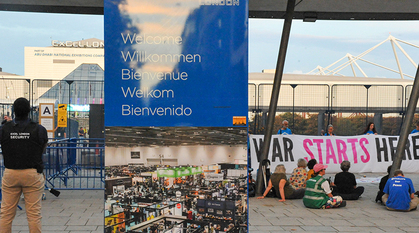
Quakers in Britain 2011 statement in support of Occupy London